

What You Actually Build with the Obstacle Avoiding Robot Kit
The Obstacle Avoiding Robot Kit with Arduino Uno + Ultrasonic (₹1,995) builds a two-wheel-drive robot that drives itself: an HC-SR04 ultrasonic sensor spots walls and furniture, a servo sweeps that sensor left and right to compare distances, and the Arduino steers toward the clearest path. It is rated Beginner, takes a realistic 3–4 hours to assemble, and is the classic first robot for a reason — you watch a machine you wired make its own decisions. Every part is included, down to the rechargeable 18650 cells, and the kit is pre-tested as a system so you are debugging your understanding, not part compatibility. If you have ever wanted to put a robot on the floor of your room and watch it find its own way down the corridor, this is the shortest honest route there.
What's in the box
A complete bill of materials: Arduino Uno R3, HC-SR04 ultrasonic sensor, SG90 servo motor, L298N motor driver, two TT gear motors, a 2WD chassis with castor wheel, two 18650 cells with holder, resistors (10kΩ and 220Ω, five each), 100nF capacitors, and 40 jumper wires (25 male-male, 15 male-female). Nothing to source separately except one thing worth knowing up front: an 18650 charger is not included, so you'll need one to charge the cells before the first run.
What you'll learn
- Ultrasonic ranging — how the HC-SR04 measures distance with sound pulses and how the Arduino turns echo timing into centimetres.
- Servo control — programming the SG90 to sweep the sensor across a field of view, turning one fixed sensor into a scanning eye.
- Motor driving — commanding two TT gear motors through the L298N for forward, reverse and turns.
- Decision logic — writing the avoidance algorithm itself: stop, scan left and right, compare, turn toward open space. This is the sensor–actuator loop that every autonomous machine is built on.
The build, honestly
Three to four hours is a fair estimate if you follow the steps in order: chassis and motors first, then power, then electronics, then code. No soldering is required. The steps that trip people up are the perennial ones for this class of robot: motor polarity (if the robot spins in place when it should drive straight, one motor's wires are swapped — a ten-second fix once you know to look), and power wiring to the L298N, where a loose battery lead causes mystifying resets. The servo sweep also needs the sensor mounted straight; a crooked bracket makes the robot favour one side. None of these are showstoppers, and each failure teaches exactly the diagnostic thinking the kit exists to build.
Who it's for — and who should skip it
This is an ideal first robot for ATL Tinkering Lab students, CBSE Class 6–10 robotics clubs, and science-exhibition builds — the product is explicitly designed for that audience, and the avoidance logic maps directly onto events like ATL Marathon challenges. It also works as a fast practical demo for engineering first-years meeting sensor–actuator loops for the first time. Parents supervising a young builder will find the steps concrete and the result genuinely rewarding.
Who should skip it: if budget is the constraint, our Sumo Robot Kit delivers a comparable beginner build for under a thousand rupees — different mission, same core skills. If you have already built a rover and want the next rung, the Maze Solving Robot Kit adds a second ultrasonic sensor and a real navigation algorithm, and the Gesture Controlled Robot Kit adds wireless control and IMU sensing. Buying this kit twice, in effect, is the only real mistake to avoid.
FAQ
Are batteries included?
Yes — two 18650 lithium cells and a holder ship in the box. You need a separate 18650 charger (not included) before first use.
Can the parts be reused for other projects?
Fully. The Uno, L298N, servo and ultrasonic sensor are the standard building blocks of hobby robotics — after this build they can become an RC car, a line follower, or any motor-plus-distance experiment.
Is it suitable for school competitions?
Yes. The obstacle-avoidance logic applies directly to many inter-school events (IRC League, ATL Marathon), and the modular build documents well for judging.
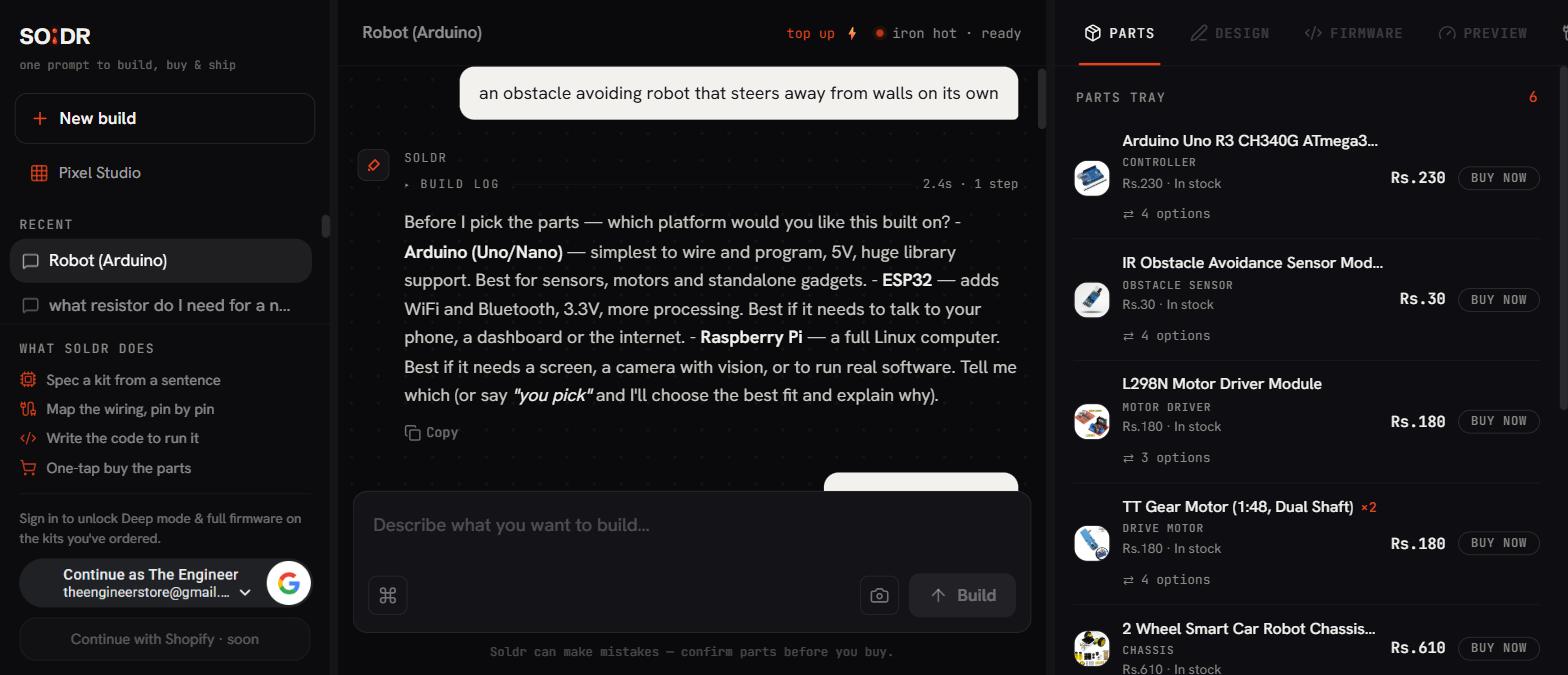
The kit arrives pre-loaded in Soldr, our AI build assistant — wiring, firmware and troubleshooting for this exact robot are generated for you the moment you open it.